
The handbrake goes on, the engine ticks as it cools, and your willingness to do admin is draining away by the second. Everyone who's done a long day on the road knows that feeling. Cockpit mode is built for the state you are in when it hits.
Why the driver's seat
Every logbook fails the same way: the entry gets postponed. You'll do it after dinner, then after the washing up, then tomorrow, and by Thursday you can't remember whether the aire outside Boulogne cost seven euros or nine. The only reliable moment to log a stop is while you're still sitting in it, belt off, hands free, details fresh.
So the app's home screen is a cockpit rather than a menu: quick logging, front and centre, arranged for someone who has just stopped driving and would like to stop admin too.
Sliders beat keyboards
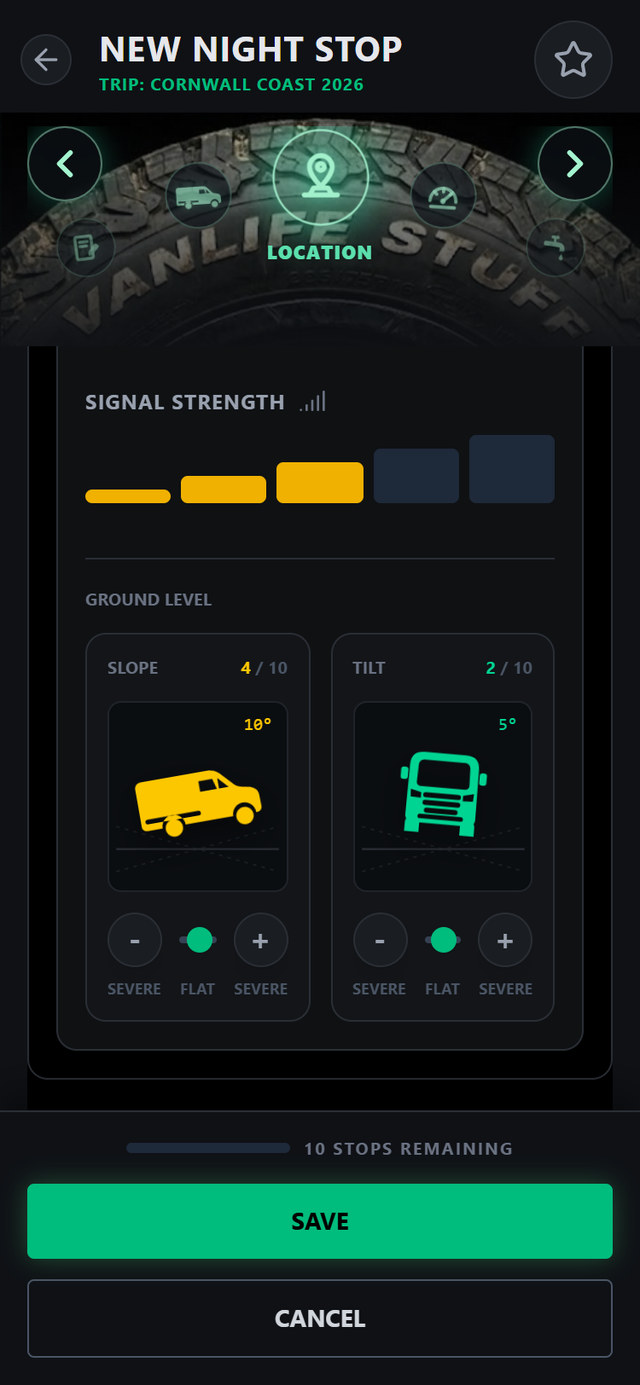
Typing on a phone in a cold cab is miserable, so cockpit mode barely asks for any. The 0–5 scores for noise, views and phone signal run on sliders you push with a thumb. Big controls take the rest, sized for a tired hand rather than a stylus. Date and time are already known. Location comes from GPS or a prod at the map picker.
The result is a screen you can work with one thumb, in the dark, with the engine off and your boots still on. That is the bar it has to clear, because that is the state you are in at 6pm in a wet lay-by.
What the first pass gets you
Enough to make the stop worth having logged: where you are, when you arrived, what kind of stop it is, how it scores, what the weather's doing. You can take the odometer off the dash while you're looking at it. If the parkup slopes, the slope and tilt go in too, so future-you knows which end to point uphill.
None of it needs signal. Everything is saved the moment you tap it, so the routine is identical in a Sainsbury's car park and a corrie in Torridon.
Forestry car park above Betws-y-Coed, rain coming in sideways off the ridge. Handbrake on, three sliders, location off the GPS, weather tagged, done. Phone back in the cradle before the windscreen had finished blurring. The heating went on next. Priorities.
Finish the entry when you feel like it
The first pass captures the perishable stuff. Everything else can wait. Later, with a brew and the heating running, you can open the entry from the history and add the slower details: notes about the approach road, facilities, costs. Nothing in the log is ever locked; every field can be edited whenever you like.
That split is deliberate. Capture is urgent and editing isn't, and an app that pretends otherwise ends up with empty logbooks. Get the bones down from the driver's seat. Put the flesh on when the kettle's boiled. If this is all new, the arrival routine in the first motorhome trip checklist is where the habit fits.
Put the cockpit on your home screen
One thumb in a dark cab, and tonight's stop is in the book. Ten stops free. No ties.